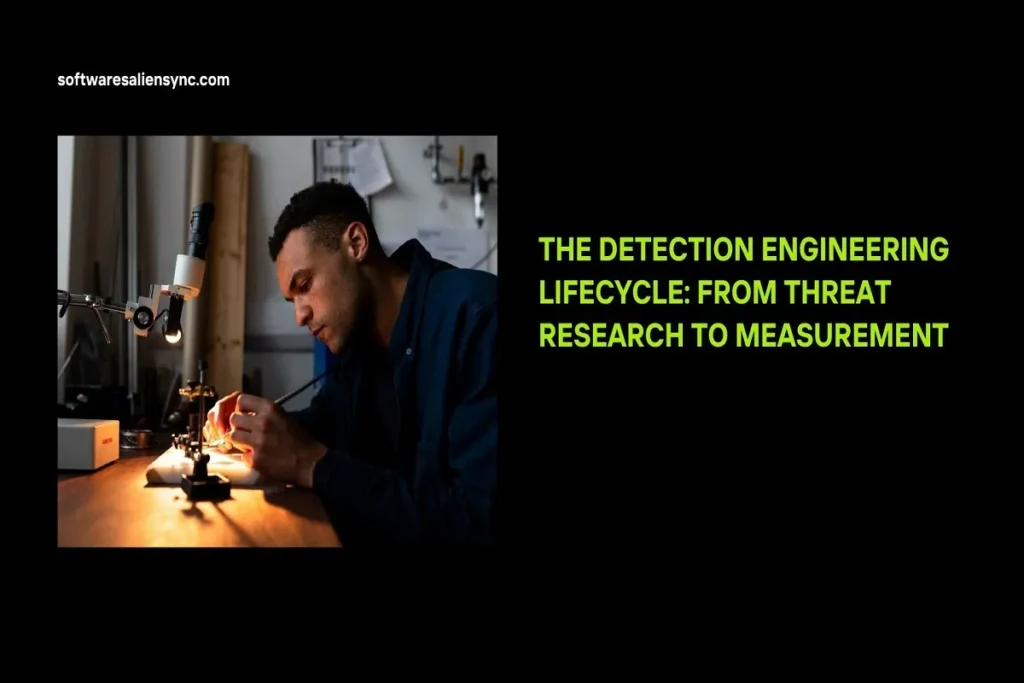
A detection rule that catches an attacker on day one and fails silently by month three isn’t a failure of that individual rule so much as a failure of process. Detection engineering works reliably only when teams treat it as a full lifecycle rather than a single act of writing logic and shipping it. Each stage, from the earliest threat research through the final measurement of whether any of it worked, shapes what’s possible at the stage that follows. Understanding this progression helps security teams diagnose exactly where their own detection program tends to break down.
Grounding the Work in Threat Research
Every reliable detection traces back to solid research about the threat it’s meant to catch. This research pulls from a mix of sources, vendor reporting, information sharing communities, internal incident post-mortems, and independent technical analysis, and the task at this stage is filtering that stream down to what genuinely applies to the organization’s own environment and risk exposure. Not every disclosed technique deserves equal attention, and treating all incoming intelligence as equally urgent tends to spread a team’s effort too thin to do any of it well.
Depth matters considerably more than breadth at this stage. A vendor’s two-paragraph summary of a malware family rarely explains enough to build a reliable detection around. Understanding precisely what a sample does, its process behavior, its file and registry activity, how it communicates outward, and what steps it takes to stay hidden, requires closer technical examination than most public reporting provides on its own.
Shaping Research Into a Testable Rule
Good research still needs translation before it becomes a rule. This early stage of the detection engineering lifecycle is where a team pins down exactly what behavior the detection will look for, which data source would actually reveal that behavior, and what separates the real threat from something ordinary that merely resembles it on the surface. A vague hypothesis here produces a vague, unreliable detection later.
Working from concrete behavioral evidence rather than a written description makes a meaningful difference at this point. A platform like VMRay lets engineers watch exactly what a sample does when it actually runs, giving them specifics to build logic around instead of inference drawn from someone else’s summary. A hypothesis built this way defines not just the trigger condition but the boundaries around it, spelling out what shouldn’t set off the rule just as clearly as what should.
Proving It Works Through Validation
An untested hypothesis is still just a guess, however well-reasoned. Validation means running the proposed detection against real or convincingly reproduced malicious samples and confirming it fires reliably, not just against the one sample used to build it but across reasonable variations of the same technique. Attackers rarely execute the exact same attack twice, and a rule tuned narrowly to one sample often misses the next one entirely.
The other half of validation checks the opposite direction, exposing the rule to benign activity that superficially resembles the malicious pattern to see whether it misfires. Detailed sandbox output from tools like VMRay supports this comparison directly, letting engineers see side by side what malicious and legitimate activity actually look like at a behavioral level rather than relying on assumption. This validation stage is where a genuine detection engineering lifecycle earns its name, since a rule that skips this comparative step tends to surface as a noise problem within days of deployment.
Introducing the Rule Through Controlled Deployment
Passing validation still isn’t a reason to switch a rule straight to full alerting. Most experienced teams run a new detection in a silent, observation-only mode first, watching how it performs against genuine production traffic for a set period before letting it start generating alerts analysts must act on. Lab conditions never fully capture the variety of an actual production environment, and this observation window is what catches the gaps lab testing missed.
A dependable deployment approach usually includes a few consistent steps:
- Logging the rule’s behavior quietly before switching on active alerting.
- Sharing early results with the analysts who’ll be responsible for responding, and taking their feedback on noise and clarity seriously.
- Recording what the rule is meant to catch, along with any known gaps or edge cases.
- Setting a specific review date to judge real-world performance before treating the rule as fully live.
Rules pushed straight into full alerting without this staged approach are among the most common reasons analysts start ignoring an entire detection program.
Keeping Rules Sharp Through Tuning
Almost no detection performs at deployment the way it will six months later. Tuning closes that gap, adjusting thresholds, narrowing overly broad logic that testing didn’t fully expose, and sometimes rebuilding a rule from scratch once production reveals a flaw in the original hypothesis. This isn’t a one-time cleanup step but an ongoing part of maintaining any active detection.
Adversaries add another reason tuning never really finishes: once a technique becomes well defended against, attackers frequently adjust their approach specifically to slip past detections built around the older version. A rule that performed well at launch can quietly degrade in effectiveness over months without anyone noticing unless tuning happens on a regular, scheduled basis rather than only after someone flags a problem.
Measuring What Actually Happened
The final stage asks whether any of the preceding work translated into real security value. Meaningful measurement goes beyond a simple tally of active rules, looking instead at coverage against known attacker techniques, how long it takes to move from initial research to a validated, deployed detection, and the sustained false-positive rate a rule generates once it’s had enough time in production to produce trustworthy data.
These findings should loop directly back into the earlier stages, pointing toward which threat categories deserve deeper research, where rule design tends to fall short on the first attempt, and which detections keep demanding heavy tuning after launch. A program that treats measurement as the start of its next cycle, rather than a report filed away once completed, is what keeps the whole process genuinely repeatable instead of drifting back toward the reactive habits it was meant to replace.
Key Takeaways
Each stage depends directly on the one before it. Research supplies the confirmed threat behavior that grounds everything else, rule design turns that understanding into something concrete enough to test, and validation against real malicious activity, sharpened by detailed behavioral analysis from platforms like VMRay, confirms a rule deserves a place in production before it gets one. Careful, staged deployment and ongoing tuning bridge the distance between lab results and live conditions, and measurement feeds what’s learned back into the cycle rather than letting it sit unused. Teams that give validation and measurement the same rigor they give research and rule writing tend to build detection programs that stay useful well after the initial rollout, rather than ones that quietly decay the moment attention moves elsewhere.
For more information, click here.